"José Antonio's thinking has achieved the timelessness of what is permanent."
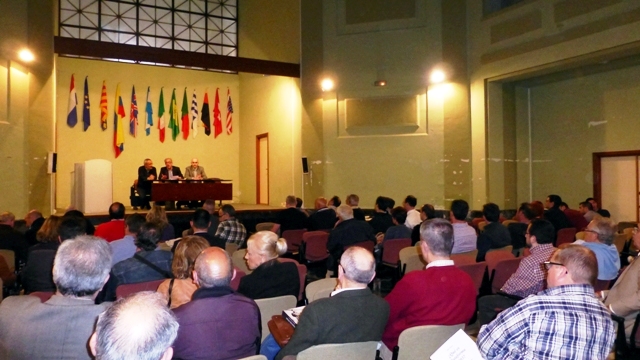
There could be no better location in Alicante for presenting Professor Francisco Torres's essential work, "The Last José Antonio," than this unique venue. This is the sole remaining space, alongside the façade, of what once served as the provincial detention center and later the "House-Prison" for many decades. Here, José Antonio spent his final months, and we stand before one of the doorways that once led to that courtyard—now transformed into a garden without memory—where he was unlawfully executed on the dawn of a November twentieth.
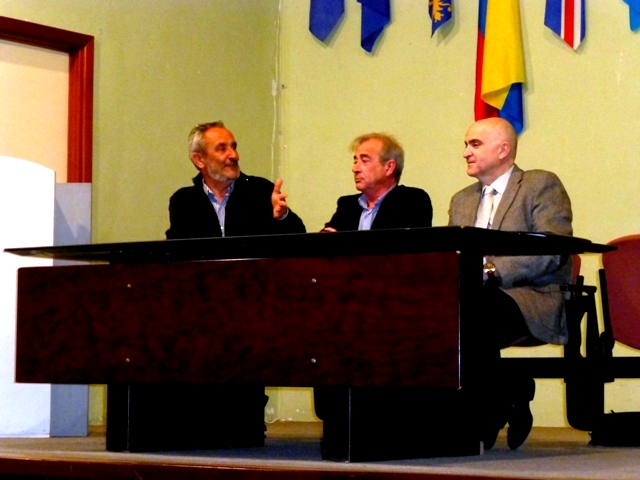
Distinguished presenters joined to introduce this work, which many consider definitive on certain aspects of the Falange founder's life. Luis Soler participated, whose only credential beyond friendship with the author was his identification as a Falangist. Professor Carlos Caballero, the heart and mind behind the historical defense of the Division's heroic deeds, also took part.
Luis Soler read a brief article written by his father, recounting the moment of the execution when he and other imprisoned Falangists at the nearby Reform School heard the gunshots that shattered the silence of a cold dawn. He emphasized not only the rigor and documentation of a work in which the history of the Falange in Alicante surfaces repeatedly, but also the author's tremendous effort in an outstanding chapter concerning the "revolutionary traditionalist or traditional revolutionary that was José Antonio." The goal was to distill José Antonio's thought from its circumstantial elements to its essence—what remains permanent. This allows us to trace the validity of his proposals against situations like those we face today.
He also highlighted the systematization of rescue attempts, which closes a debate as pointless as it has been sterile, one that for years conditioned behaviors regarding Franco's position on attempts to rescue José Antonio. He recalled how Narciso Perales remembered the day they came to arrest José Antonio at his office, when they suggested he escape through one of the windows, but Primo de Rivera had profound faith in Justice—he believed in Justice.
Carlos Caballero portrayed the subject by recalling a case José Antonio handled before entering politics around 1926, defending peasants from Malagón against landowners. Even before entering politics, José Antonio prioritized social justice above all other considerations. He noted that this is a very dense book, requiring continuous reflection from the reader, yet at the same time, thanks to its narrative style—almost cinematic in many pages—it proves highly engaging. Dozens of characters move through its pages, where the author demonstrates mastery of the historical period unfolding in Spain to offer a different and more truthful reading of many documents. The work rests on a documentary apparatus reflected in approximately 900 notes that prove fascinating for historians.
Carlos Caballero highlighted the ease with which Francisco Torres dismantles not only the myths about José Antonio constructed by the left, but also many myths originating from Falangist sectors, reducing many previously published works to mere milestones.
Professor Torres began his intervention with emotion. Like Luis and Carlos, he wanted to recall the times since their youth when they made pilgrimages to this place. From the room where we gathered, he pointed out the locations, depicting that night from the 19th to the 20th of November. He carefully detailed what the documentation tells us about the execution, which bears little resemblance to some recent versions. The reading of a letter from one of the young men executed with José Antonio—already pardoned when they were murdered—made a profound impression in that place.
He explained the purpose of his research and, echoing Luis Soler's words, clarified that his José Antonio is not merely a historical figure because he was also a thinker, an ideological architect. Therefore, he needed to reread the Falange founder through his prison writings, through what he said at trial, to purify his thought from what was strictly circumstantial and arrive at that minimum of what is permanent, where his words become timeless and thus a valid source for political construction.
An engaging question period followed, during which the younger members of the audience asked the panel whether José Antonio's thinking remained valid, whether it could be applied to today's circumstances and Spain. All three speakers agreed that it does. At one point in the debate, Luis Soler asked Francisco Torres if he could imagine "an aged José Antonio." The response was: "No, and that is one of the permanent attraction points of José Antonio's figure, because his biography has become one more ideological element, the embodiment of an exemplary form of being and existing, of facing life's challenge with commitment, a personification of what political ethics should be."
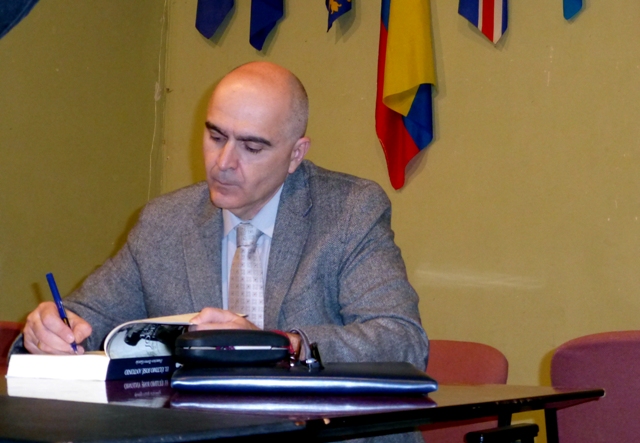
After the event concluded, following the signing of copies of "The Last José Antonio," those who remained, inspired by the atmosphere, sang the Cara al Sol as a tribute to José Antonio.
5 responses to Chronicle of the Alicante Presentation of "The Last José Antonio"
The idea seems brilliant.
Reality: At the Brotherhood in Barcelona, we're in wartime economy. Thanks to comrades affiliating from other provinces, we're managing to maintain facilities and activities.
Attracting more people: We'd like to know how to do it.
The separatist environment is no joke. A space for 50 people has been sufficient until now. Hopefully the day will soon come when it becomes insufficient and we're forced to seek an alternative.
Many thanks.
Since Professor Torres will be in Barcelona presenting the book, we could take advantage and hold the event in a larger venue attracting more people.
I'm very envious. What a beautiful hall. In Barcelona we have to make do with the limited space of the Brotherhood hall.
Ours also has its charm. It has more of a catacomb atmosphere.
Little by little things are livening up; hopefully soon we can hold events in larger capacity halls.
A 10 for the Alicante comrades.
Let's see when Hispana Vista readers residing anywhere in Spain decide to organize events like this in their localities.
We're in a position to provide them with all the information and logistical support so any comrade can do it.
There are more proposals on the table. The organizers are working on it, and as soon as they confirm, the details will be published.
Madrid and Barcelona are already well consolidated, though we must keep stoking the fire. All together, like in Fuenteovejuna. It's unfortunate that lifelong comrades, with very well-equipped minds, have lost faith. Why do we want angels without wings? I speak of specific cases. And I like to remember Teresa of Avila: "Even if I tire, even if I cannot, even if I collapse, even if I die."
The Alicante comrades deserve applause, however I'll stick with Ceferino's phrase in Barcelona: we don't want applause, we want ARRIBA ESPAÑA.