Today, when voices in the streets declare that people come first and the economy must serve humanity, they are raising the banner of ideals that José Antonio championed.
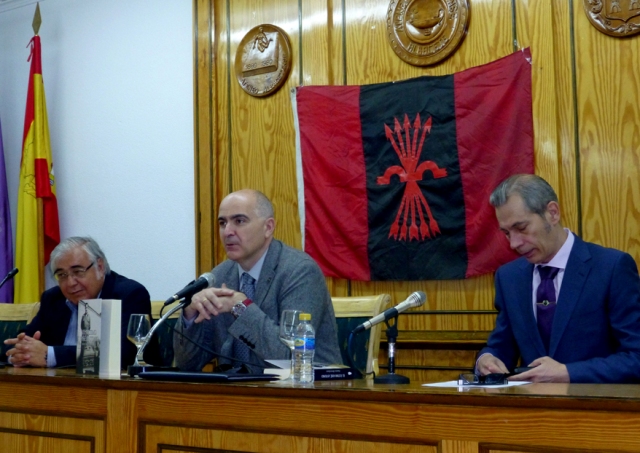
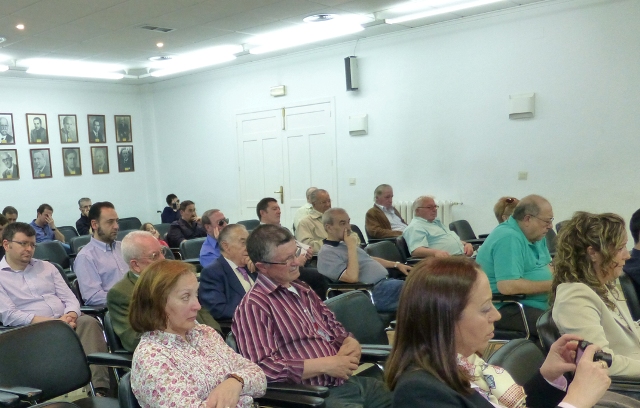
On May 25th, the Albacete cultural center hosted a presentation of Professor Francisco Torres García's book "The Last José Antonio," an event organized by the Brotherhood of the Old Guard. Carlos Batres, president of the Old Guard, traveled to the region to attend the event and invited the author to present his work at the Madrid headquarters on Cuesta de Santo Domingo after the summer break.
Alfonso López Cirugeda introduced both the author and his scholarly work, emphasizing the extensive research that resulted in this six-hundred-page volume featuring over nine hundred footnotes. This documentation, much of it previously unpublished, offers a fresh perspective on a work that many consider definitive in several respects. He recalled that Professor Torres had previously spoken at the same venue years ago about another topic in which he specializes: the Russian campaign of the Blue Division.
"This is a book that seeks not only to reconstruct the final months of his life but also to explain José Antonio himself. It is written with contemporary relevance and aspires to be the first book about the founder of the Falange for younger generations drawn to his legendary figure." According to Professor Torres, it is essential—and he has dedicated a portion of his work to this—to demythologize José Antonio in a practical sense: "to strip away all the distorting layers and cleanse the accumulated reconstructions that have obscured the real person. This is not about eliminating the positive and purposeful aspects of the myth—those that present him as a symbol, as an example, as embodying a way of walking through life in accordance with one's own guiding star, as José Antonio himself put it." He denounced newer myths that attempt to reduce his figure to that of a tragic or romantic hero, at most making him an archetype, even if his ethical dimension is correctly preserved, while preventing him from continuing to be a figure of political attraction for what he actually said.
This explains why this work dedicates a chapter to explaining his concepts through writings from the last months of his life—a period during which José Antonio, according to Professor Torres, attempted to systematize his thinking, "purifying them of their contextual burden to discover or rediscover what is permanent in his concepts." He then summarized the contributions of "The Last José Antonio" to history: the reconstruction of the execution, the in-depth analysis of the trial, and the topic of rescue attempts. He focused on the maneuver by leftist leaders—both socialists and anarchists—who bore responsibility for the execution-assassination, to conceal their tracks. As is his custom, Professor Torres opened a discussion period where we heard his reflections on the contemporary relevance of José Antonio's thought: "We have returned, as in a loop, to the moment of capitalist crisis that José Antonio witnessed—different but similar—with the speculative elements, loss of sovereignty, and injustice generated. When today people cry out in the streets that people come first and the economy must serve humanity, they are raising José Antonio's banner."
Afterward, a well-attended Brotherhood lunch took place in a relaxed atmosphere where future plans and projects were discussed.
One Response to "Report on the Presentation of 'The Last José Antonio' in Albacete"
We must remember that man is the bearer of eternal values.
AE.
Leave a Comment