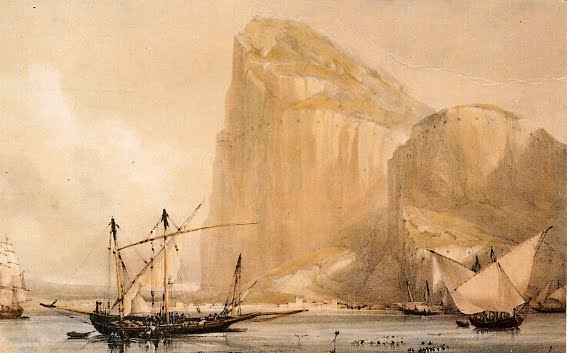
"Spain's southern border ends with the shame of Gibraltar"
We are approaching the three-hundredth anniversary of the seizure and subsequent handover of Gibraltar to England. Three centuries during which every conceivable approach has been attempted: surprise military assaults, negotiations of every stripe, policies ranging from strict border closures to tolerance, respect, and diplomatic dialogue. Yet nothing has borne fruit. Like certain individuals, some nations only respond to firm pressure and decisive action—only then do they pause, reflect, and listen to reason.
Looking back, we know that in the August heat of 1704, against the backdrop of the War of Spanish Succession, a fleet of British and Dutch vessels (carrying Catalan troops) fighting for the pretender Charles to the Spanish throne engaged the modest Bourbon Spanish garrison defending this territory. With overwhelming numerical superiority, they defeated the defenders. Following this, the resident population departed, taking with them all their possessions and even official records, heading toward a nearby hermitage that would eventually become San Roque—thus creating that town's founding charter. When hostilities ended and forces loyal to the future Philip V could not reclaim the fortress, British possession was formally recognized in the Treaty of Utrecht, signed in 1713 after the war's conclusion.
This conflict was merely one more in Spain's long series of civil wars—and, as always happens, the perfect moment for those seeking to claim the spoils. In this manner, Spain lost to Austria: the Duchy of Milan, Naples, Sardinia, and Flanders; to Portugal: Paraguay; to the House of Savoy: their namesake territories, Sicily, and Nice; and to England: beyond what brings us here today, the island of Menorca and Caribbean concessions.
Despite several eighteenth-century attempts to recover Gibraltar (successfully in the case of Menorca), the territory ultimately received colonial status from Britain in 1830, with a "neutral zone" created on the isthmus between the Rock and Spanish fortifications. This space was never respected. In 1815, when a yellow fever epidemic struck, Spain granted permission for humanitarian reasons to construct hospital facilities. Once the outbreak passed, Britain never returned this land. A similar occurrence happened in 1854, and ultimately the British erected "the fence" on their side in 1909, leaving much of the Spanish isthmus under Anglo-Saxon control.
During the Spanish Civil War (specifically in 1938), an airfield was constructed on this territory—a fait accompli that ensured it would never be officially recognized. Since then, Spain has brought the Gibraltar situation before the United Nations, with the General Assembly adopting numerous resolutions calling for an end to this colonial reality. From that moment, Britain has transformed Gibraltar's status from colony to "British Overseas Territory," conducting several absurd referendums and even granting the Rock its own constitution.
All these British actions repeatedly violated the Treaty of Utrecht, prompting Spain to suspend land communications until 1982. The remaining history is well known to all.
The historical circumstances by which Gibraltar passed to British hands, as well as the laws and principles underpinning them, have undergone remarkable changes. This must be taken into account. And given this, what can be said about maintaining colonial status, especially when embedded within Europe itself? Well, it appears Britain considers none of this and instead maintains an obstinacy that contradicts law, common sense, and the times: reinforcing the Rock's legal-political status and encouraging the phantasmagorical idea of "self-determination." Without dwelling too long on this concept, we should understand it was conceived by those who won the Great War and, like everything birthed in democracy, is applied selectively. Even by its original definition, it doesn't apply to this territory for various reasons—among them that the area's native population doesn't inhabit the ancient Mount Calpe but lives several kilometers inland, having been replaced by an influx of foreigners (Genoese, Maltese, Jewish, Indian, and North African).
The constant and repeated infractions of the Treaty of Utrecht by the British add, if possible, more weight to arguments supporting the invalidity of what enables the Rock to remain non-Spanish.
Gibraltar was once an indispensable enclave within a communications system that no longer exists in our time. The construction of a vital Mediterranean route consolidating British empire—formed by Gibraltar, Malta, Cyprus, and Suez—was fundamental. Today, its existence makes no sense. Yet England not only ignores United Nations directives but periodically provokes with various actions that aggravate a discomfort lasting far too long (such as challenging jurisdiction over parts of the Strait's waters, seizing fishing vessels, and very recently including sports sections with "international" character).
The continued British existence of this Overseas Territory is historical and political nonsense, a persistent offense, and only possible because it serves as a premier money-laundering center. In its seven square kilometers, so many shell companies crowd together that mentioning them wastes time. We know that if all the companies claiming to exist there were actually located there, they simply wouldn't fit. How is this permitted? For the same reason other tax havens are allowed to exist in the continent's very heart.
At this stage, after three hundred years, nothing remains but to effectively demand its return. First, strict compliance with the Treaty. That is, the colony should be limited to the Rock, the square, and the castle—and therefore immediate occupation of the isthmus with everything on it should occur, and if force is necessary for this, so be it; that's what the Legion exists for. This should come with complete border closure, accepting all consequences: isolation of its people and the costly economic hardship for Gibraltar such a course would entail. Without remorse, because to the enemy, not even water. Otherwise, all that remains is to wait another three hundred years for its reintegration, or more or less to trust that, as legend has it, the English will lose their possession when Gibraltar's last Barbary macaque dies.
6 Responses to "The Gibraltar Question"
Who even remembers Gibraltar?
While Spain continues being—according to the plutocratic oligarchy's convenience that dominates it as a territorial section of what already dominates almost the entire planet—either a "brand" (the nauseating "Spain Brand," which converting Spain into that is mockery of our History and intelligence as a people) or "the Spanish State," and the United Kingdom continues operating as a Nation, we're screwed for taking the necessary steps to recover Gibraltar as part of an almost completely finished Spain.
Total... What power can a "brand" or a mere "State" have against a Nation that still knows and sees itself as such and is, moreover, organized as a State?
If the majority of Spanish society doesn't care that Spain has been carved into 17 Autonomous Communities and that 2 or 3 of them want independence, how could they care that a piece of Spain belongs to the English.
What a shame, right?
Magnificent article.
Mr. Paz, it is always a pleasure to read your texts.
April 11, 1713, day of the signing of the Treaty of Utrecht, day of infamy and a day that has passed without sorrow or glory for the blue world when the 300th anniversary of the theft was reached.
I am nobody, but at the very least organizing a demonstration at the fence or an "excursion" by bus to Gibraltar, this date should have great importance, not as much as a 20-N (for José Antonio) or a 12-O, but somewhere around there and, nevertheless, it has gone unnoticed, even by me, if it weren't for Carlos Paz's reminder, so there you have it, now all we have left is to get revenge on the football field, once the license has been granted for Gibraltar to compete in official tournaments as just another country.
This was the inauguration of the Bourbon dynasty in Spain